

Back in 2019 I published a list of five marketing books on this site. It had Kotler at number one, as was proper, and four other titles everyone in the industry had read around then. In 2021 I changed the title to make it look fresh, which, I'll admit, isn't quite the same as updating it.
I reread it last week and felt slightly embarrassed. Not because it was wrong, but because it was the list of someone who wanted to look well-read, not the list of someone who actually puts these books into the hands of the people he works with.
Because that's what I do, in practice. Over the past few years I've handed books to brand managers and, a few times, to marketing directors, usually after a meeting where we'd argued politely about a budget decision and I could feel my argument wasn't landing, because I had nothing to point to. The books below are the ones I've handed over most often.
None of them is about digital marketing, and that's deliberate: books about digital age at the same speed as the platforms, and a chapter on Facebook written in 2018 is a historical document by now. These are books about how people buy and how brands grow, which doesn't change when Meta changes the algorithm.
Six made the cut. I've put them in the order I think they read best one after another, not in order of importance, although the first one is also the most important. At the end I explain what I dropped from the old list and why, because that says more about how we think now than the list itself does. And if you learn better from courses than from books, I recently rewrote our guide to free digital marketing and social media courses along the same lines.
01Byron Sharp, How Brands Grow
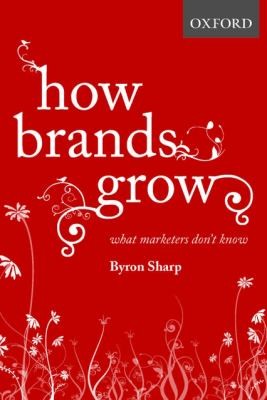
If you read only one book from this list, read this one, and read it before the others, because every other book here leans on it one way or another. It came out in 2010, there's a second part from 2015 written with Jenni Romaniuk, and it is not a book of opinions.
Sharp runs the Ehrenberg-Bass Institute in Australia, and he pulled together decades of real purchase data, across dozens of categories and countries, to see what repeats. What repeats contradicts a good part of what gets said in marketing meetings, including ours.
The idea that hit me hardest: big brands and small brands have customers who are about equally loyal. The difference between them isn't loyalty, it's the number of customers. A brand with 30% market share doesn't have people who love it more than the people buying the brand with 3%, it simply has ten times as many people picking it up now and then.
And "now and then" is the important part, because most of any brand's buyers are light buyers. Not the fans. The people who buy your product twice a year without thinking much about it, because they saw it, recognised it and it was within reach.
Which leads to the conclusion that stings: growth comes from reaching more of those people, not from getting the existing ones to buy more often. Loyalty programmes, fan communities, engagement with the 40,000 people who follow your page are all talking to people who were going to buy anyway.
What Sharp puts in their place are two things with ugly names and a simple meaning:
- Mental availability. How likely your brand is to come to mind at the exact moment someone needs something from your category. Not "how well known it is", but how readily it surfaces, tied to that particular situation.
- Physical availability. Once it has come to mind, how easy it is to find and buy: on the shelf, in the app, wherever.
Seen through this lens, social media isn't a relationship channel, it's a channel for building mental availability among as many people as possible, as often as possible, as recognisably as possible. It completely changes what you ask your agency for. I've handed this book over at least ten times so far, and every time the next meeting was a different meeting.
02Les Binet and Peter Field, The Long and the Short of It
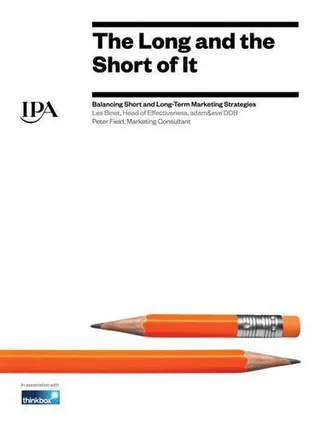
Strictly speaking it isn't a book, it's a report of about 80 pages published in 2013 by the IPA, the UK advertising agencies' association. It's on the list because it's the document I send whenever a client asks, usually in November, why we shouldn't move next year's entire budget into performance, since performance "shows up in the numbers".
Binet and Field took several hundred campaigns that had won effectiveness awards, with real business results behind them, and looked at what made them work. They found two kinds of effect that behave completely differently:
- Activation. Promotions, performance, retargeting, anything that asks for a click now. It produces immediate, measurable results that vanish the moment you stop spending.
- Brand building. It produces results that arrive late, sometimes months later, and don't show up well in a weekly dashboard, but they accumulate: the sales base grows year on year, people become less price-sensitive, and future activations work better because they have something to stand on.
A brand that lives on activation alone has a sales chart that looks like an ECG: a spike at every promotion, a drop in between, and a baseline that drifts slowly downwards, because nobody is building the reason the product would be worth buying at full price. I've seen that chart at clients who couldn't understand why promotions "don't work the way they used to". They worked exactly the same. They just had nothing left to stand on.
It's an average across many categories, not a rule, and the authors themselves refined it in later work, because an online retailer looks different from a beer. But it's an infinitely better starting point than "this year we're only doing performance, there's a recession". If you have a budget conversation coming up with your CFO, bring them this report, not the agency's arguments. Data from people who aren't selling you anything carries more weight. We wrote about the same problem in Sometimes marketing tries to do too much.
03Jenni Romaniuk, Building Distinctive Brand Assets
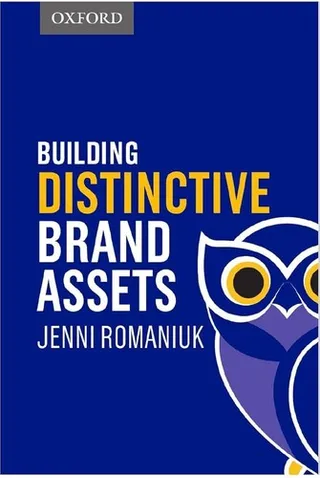
This is the book on the list that the fewest people outside agencies have heard of, and the most practical of the six for anyone working in social media. Romaniuk is Sharp's colleague at Ehrenberg-Bass, and she took one of his ideas, probably the most counter-intuitive one, and followed it all the way through.
The idea is that brands don't need to be different, they need to be distinctive. It sounds like wordplay, but it isn't. Different means "we're better than the others because...", and that's hard to hold on to, because competitors copy and because, honestly, consumers don't retain the argument.
Distinctive means the brand is recognised instantly, without effort, through things that belong to it alone: a colour, a pack shape, a character, a sound, a typeface, a phrase. When someone is standing in front of a shelf or scrolling a feed with their thumb, they aren't comparing arguments. They either recognise it or they don't. And if they recognise it, the mental availability Sharp talks about has just kicked in.
The genuinely useful part is that Romaniuk shows you how to measure this rather than just assert it: two questions, put to consumers about each element separately. How many of them link it to your brand, and how many link it to your brand only and not to anyone else's. An element lots of people recognise but also associate with a competitor isn't an asset, it's a cost you're paying on behalf of the whole category.
For social media, three rules follow, which I repeat at every brief:
- Recognisable in the first second. The clip has to be identifiable as yours with the sound off, without waiting for the end-frame logo that nobody sees anyway.
- Not changed out of boredom. Distinctive elements don't get changed every campaign because the team is bored of them. Consumers have only just started noticing them by the time we want something new.
- A rebrand has a cost. More often than not it is a destruction of capital that no consumer asked for.
- The five-minute test
- Take the brand's last 20 posts, cover the logo with your thumb and count how many are still recognisably yours. If you don't like the answer, the book tells you what to build and how to check, a year later, that it got built.
04Rory Sutherland, Alchemy
Sutherland is the vice chairman of Ogilvy in the UK, someone you probably recognise from conference stages, and his book starts from an uncomfortable observation: the best marketing ideas don't survive logical scrutiny, which is exactly why they never make it into the meeting. In a meeting you can only defend what looks rational, so what stays on the table are the reasonable ideas, and everybody has the reasonable ideas.
His favourite example is Eurostar. When the London to Paris train needed improving, the engineering answer was to spend billions making the journey about 40 minutes shorter. Sutherland's point is that for a fraction of that money you could have put in good wifi, better seats and champagne, and people would have asked for the journey to be longer.
Nobody proposed it, because it isn't an idea you can justify in a spreadsheet. For the rest of the book he shows, with dozens of examples like that, that people don't buy the objective value of a thing, they buy the value they perceive, and perception can be changed for a lot less money than the product.
It isn't a method, it's a way of thinking, and that's what makes it useful at brief stage. The question I started asking after reading it is simple: what would the logical answer to this brief be, and what would happen if we did the exact opposite? If the whole category is saying "cheaper", maybe the only position left is "more expensive, and here's why".
It doesn't work every time. But a few times a year it works spectacularly, and those few times are the difference between a brand people notice and one they don't.
It's funny, it reads quickly and you'll catch yourself quoting it in meetings. If you prefer audio, the English edition is read by Sutherland himself and is, I think, better than the printed book.
05Richard Shotton, The Choice Factory
After Sutherland, Shotton follows naturally, because Shotton is the practical half of the same idea. The book has 25 short chapters, each about a single psychological mechanism, each with the experiment that proves it and the way it applies to an ad. It reads in two evenings. I keep it on my desk and open it at a chapter whenever a brief refuses to come together.
You'll recognise things in it that you've already done without knowing they had a name. Four examples:
- The pratfall effect. A brand that openly admits a small flaw becomes more believable on everything else it says, because nobody trusts perfection. "We're not the cheapest" is, strange as it sounds, the most persuasive opening for a price argument.
- Social proof. "Best-selling in its category" does more than any list of benefits, provided it's true and checkable.
- Price relativity. The same price looks expensive or cheap depending on what sits next to it, so the order of products in a carousel matters more than their descriptions. I've seen it in test after test and it still surprises me.
- Context. The same ad performs differently depending on the mood someone is in when they see it, which explains how a good clip can die, through no fault of its own, in a feed full of bad news.
If you have a social media manager on your team, give them the book and ask them to pick three mechanisms and test them over the next month of content. It's the fastest way I know of making copy better without changing the agency, the team or the budget.
06Jonah Berger, Contagious
The oldest book on the list, from 2013, and the only one I hesitated over. I kept it because the mechanisms in it haven't moved an inch in 13 years; only the platforms they play out on have changed. Berger teaches at Wharton and spent a decade asking why some things spread and others, just as good, don't. He landed on six ingredients, and I won't list them all here, because one of them is worth the whole book on its own.
Subscribe to the newsletter.
Like how we think? Get an article like this one twice a month.
That ingredient is the trigger. Berger shows that people don't talk about the things they love most, they talk about the things that come to mind most often, and things come to mind because something in daily life reminds them. His example is Kit Kat, which grew its sales by attaching itself to the coffee break, a moment that happens several times a day, every day, without the brand having to spend anything to make it happen.
A brand tied to a concrete moment (breakfast, the drive home, Friday evening, the first day of a holiday) gets mentioned and bought more often than one that is merely "loved", however well it scores in brand studies. It is, in fact, Sharp's mental availability seen from the other side: Sharp tells you the link has to exist, Berger shows you how it gets built.
What changed for me after reading it is a request I no longer accept from anyone, including us: "we want something viral". It's not a request anyone can answer. "We want content tied to a moment in someone's life" is.
07What I dropped from the old list, and why
Kotler's Marketing 4.0 was at number one in 2019 more out of respect than usefulness. It's a book about what's happening in marketing right now, and "right now" in 2016 lasted about two years. Marketing 5.0 and 6.0 have come out since, with exactly the same problem. I have nothing against Kotler; I learned marketing from his textbook, like everyone else. But the books above tell you why things happen rather than what is happening, and only the first kind is still valid five years on. The other four:
- Building a StoryBrand. Still a good book for a founder writing their own website who needs a clear message structure. For a brand manager in a large company, with an agency, a brand that's been around for 30 years and ten people with a say on every sentence, its framework is too simple and too focused on conversion.
- The Power of Moments. A lovely book about why we remember some experiences and forget others, but it isn't a marketing book. I suspect it made the list because I'd enjoyed it.
- This Is Marketing. Seth Godin's book is easy to quote and hard to apply; it's more a collection of good aphorisms than something you can build a plan on.
- The 12 Powers of a Marketing Leader. A book about careers, not brands, and it belonged in a different article.
None of them is a bad book. They simply don't pass the test: would I put this on the desk of a brand manager who has to decide, next week, what to ask the agency for?
08What order to read them in
- Just one
- Sharp. It's the book the other five start from, and the one you'll quote most often over the next few years, sometimes without realising you're quoting it.
- Two
- Sharp and Shotton. The first changes your strategy, the second changes next week's copy. Strategy without execution stays a slide, and execution without strategy is just well-written noise.
- All six
- In the order above, the order in which they lean on each other. About 1,500 pages, a year of reading at a normal pace, with breaks.
That's not much for what you get back, and I say that as someone who paid in years of meetings for things he could have learned from a chapter.
09Questions we get asked a lot
Are any of these available in Romanian?
Two of them: Contagious (as Contagios, Publica, 2015) and Alchemy (as Alchimie). The other four are English only, as far as we know. If English slows you down, start with the two translations and then move on to Shotton, whose chapters are five pages long and written in very plain English.
Why is there no social media book on the list?
Because the good ones age within two years, and the ones that don't age turn out to be about human behaviour rather than platforms. Romaniuk and Berger are, in practice, the best social media books I know, even though neither has the words in the title. For the platform side, the free courses in our guide to free digital marketing courses are a better fit than any book, because they update along with the platforms.
Are there audiobooks?
Alchemy, read by Sutherland, is the best audio version on the list and possibly the best marketing audiobook I've listened to. Contagious and The Choice Factory are available in audio too. Sharp and Romaniuk have charts and tables, so they're for reading, not listening. The Long and the Short of It is a PDF.
How often do you update this list?
This is the second version in seven years, and the first written to a criterion rather than to what was fashionable. We'll revisit it when a book comes along that passes the test, not every January.
10Six books, a year of reading
Six books, a year of reading. If you finish them, you'll know more about how brands grow than some of the people selling you marketing services, and I say that knowing we're among them. We don't mind. Clients who've read these books ask harder questions, and the campaigns come out better because of it.
There are more pieces on what's changing in social media and digital for large brands in Romania in Insights, with opinions, not press-release summaries.