
Selling direct to consumers (D2C) looks like a natural approach that works for everyone. In reality, the logistics, finance and marketing effort involved is considerable, a business in its own right. That's why so many products from big brands can only be bought through third parties and middlemen.
As more communication moves online, D2C sales are gaining ground, and social commerce adds something new to the direct-sales strategy of big brands. We wrote this article in 2022 and updated it in October 2026.
01What social commerce is
Social commerce means selling products and services directly through social networks: discovering the product, researching it and, ideally, paying for it all happen on the platform. It isn't the same as e-commerce, which happens on the merchant's own website or app.
- Social commerce
- You discover, choose and pay for the product inside the social network.
- E-commerce
- You buy on the shop's own website or app.
- In Romania, today
- You discover the product on social media but complete the order on the shop's website.
02Where you can sell today
The figures come from TikTok and eMarketer. Almost every major platform now has its own shopping tools, but they work in different ways.
Facebook and Instagram
Facebook launched Facebook Shops in early 2020, building on what Marketplace and Instagram Shopping already offered. A Shops storefront is easy to set up, sits on the merchant's business page and can be promoted across all of Meta's apps: Facebook, Instagram, Messenger and WhatsApp. Don't confuse it with Marketplace, which is more of a classified-ads board.
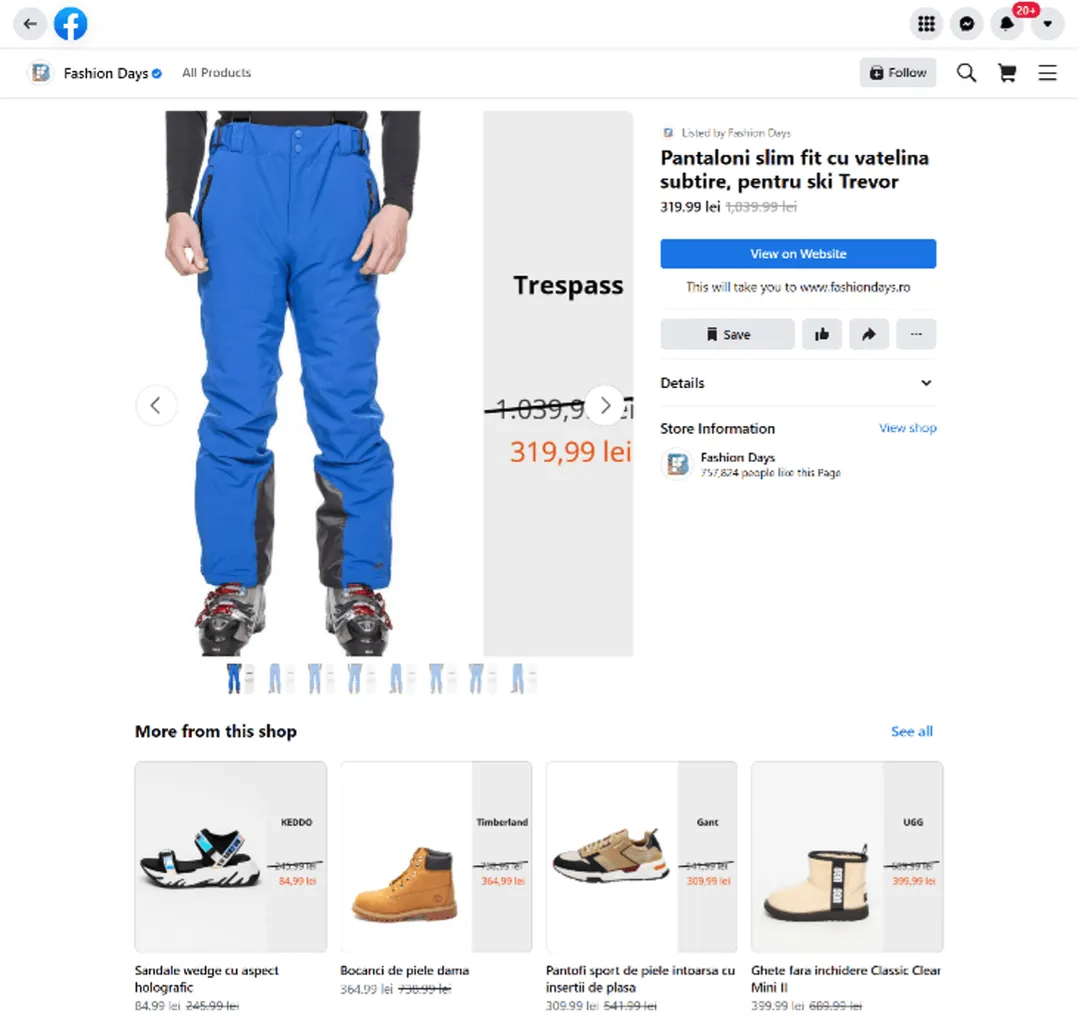
In-app checkout never reached Romania, and Meta has since dropped it where it did exist: since summer 2025, shoppers discover products on Facebook and Instagram but complete the order on the merchant's website. A Romanian example of a Facebook shop is Fashion Days:
TikTok
TikTok went the other way and launched TikTok Shop, with checkout inside the app through shoppable videos and livestreams. In Europe it runs in France, Germany, Ireland, Italy, Spain and the UK, and since 15 June 2026 in Austria, Belgium, the Netherlands and Poland too. Romania isn't on the list yet, so for Romanian brands TikTok is still a discovery channel rather than a place to sell directly.
In the US, where TikTok Shop has been running longer, eMarketer expects its sales to pass $20 billion in 2026.
Pinterest, which is fairly popular in Romania too, lets creators add shopping links to their content. Other networks may well bring out their own native shops.
Subscribe to the newsletter.
Like how we think? Get an article like this one twice a month.
03Why big brands should care
When you build an omnichannel strategy, social commerce deserves a place next to Modern Trade, Traditional Trade, Online and D2C, especially if you already sell directly from your own site. Big retailers, offline and online, are under pressure to diversify, and brands can be present on social media through direct sales as well as content. The advantages:
- Control over the experience. The brand decides what buying looks like, from discovery to order.
- A natural fit. A shop on Facebook, Instagram or TikTok sits where people already spend their time, especially those who already follow the brand.
- Data on loyal customers. Direct access to them shows what they prefer and what could be improved to raise conversion.
04What's next
Big brands were slow to get onto the web and onto social networks, and both times they caught up on the way. Social commerce isn't going away: the communities around brands matter more and more to a product's success. For now it works best in lifestyle: fashion, luxury, beauty and travel. But it's early days, and other categories will look for ways to sell directly too.
A common mistake is to judge social commerce only on short-term sales. It belongs in an overall direct-to-consumer strategy. Beyond revenue, a good buying experience improves how people see the brand and helps marketers get to know their customers better.